
Learning SEO can feel exciting at first. You create a website, publish content, and wait for visitors to arrive from Google. But many beginners quickly discover that getting traffic is not as easy as publishing a few articles.
The reason is simple: small SEO mistakes can prevent even good content from ranking.
Fortunately, once you know what to look for, most SEO errors are simple to correct.
In this guide, you’ll learn the most common SEO mistakes beginners make and how to avoid them so your website can grow faster in 2026.
Why SEO Mistakes Matter
Search engines can better comprehend your material and display it to the appropriate audience with the aid of search engine optimization, or SEO.
.
When SEO is done incorrectly, Google may struggle to understand your pages, which can lead to:
- Lower rankings
- Less traffic
- Poor user experience
- Slow website growth
Avoiding common SEO mistakes can save you from months of frustration.
How to Rank a Blog Post on Google
1. Choosing the Wrong Keywords
Many beginners target extremely competitive keywords.
For example, trying to rank for a keyword like “SEO” is very difficult for a new website.
Rather, concentrate on particular long-tail keywords like:
- SEO tips for beginners
- How to learn SEO in 2026
- Free SEO tools for bloggers
Long-tail keywords are easier to rank for and usually bring more targeted visitors.
2. Ignoring Search Intent
Search intent means understanding what users actually want when they search.
If someone searches for:
“How to start a blog”
They want a step-by-step guide, not a sales page.
Always create content that matches user expectations.
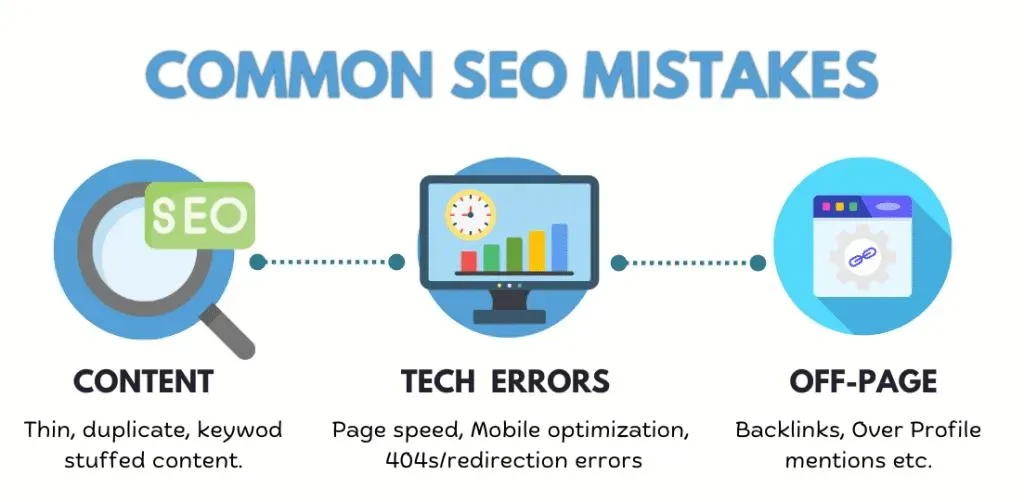
3. Keyword Stuffing
One of the oldest SEO mistakes is repeating keywords too many times.
Bad example:
“SEO tips are the best tips because it helps SEO rank.”
This sounds unnatural and creates a poor reading experience.
Use keywords naturally throughout the content.
4. Writing Thin Content
Google prefers detailed, useful content.
Many beginners publish articles with only a few hundred words and very little value.
Instead, create content that:
- Answers questions completely
- Provides examples
- Solves problems
- Offers practical advice
Helpful content performs better in search results.
5. Ignoring Title Tags
Your title is one of the first things users see in Google search results.
A weak title can reduce clicks even if your article ranks well.
Good SEO titles should:
- Include the main keyword
- Be easy to understand
- Encourage curiosity
Example:
“Common SEO Mistakes Beginners Make in 2026”
6. Forgetting Meta Descriptions
A meta description helps users understand what your page is about.
Many beginners leave it blank.
A strong meta description can increase click-through rates and attract more visitors.
7. Poor Website Structure
If visitors cannot easily find information, they may leave quickly.
A good website structure includes:
- Clear navigation
- Categories
- Internal links
- Easy-to-read layouts
Both users and search engines appreciate organized websites.
8. Not Using Internal Links
Internal links connect one page of your website to another.
Benefits include:
- Better navigation
- Improved crawling
- More page views
- Stronger SEO structure
Every new article should link to relevant existing content.
9. Ignoring Image Optimization
Large image files can slow down websites.
SEO image optimization includes:
- Compressing images
- Using descriptive file names
- Adding ALT text
Optimized images improve speed and accessibility.
10. Slow Website Speed
Speed is an important ranking factor.

A slow website can:
- Increase bounce rates
- Reduce user satisfaction
- Hurt rankings
To improve speed:
- Use caching
- Compress images
- Choose quality hosting
- Remove unnecessary plugins
11. Not Making the Website Mobile-Friendly
Most people browse the internet using smartphones.
If your website looks bad on mobile devices, visitors may leave immediately.
Always test your website on:
- Smartphones
- Tablets
- Different screen sizes
A mobile-friendly website is essential.
12. Publishing Duplicate Content
Copying content from other websites is one of the biggest SEO mistakes.
Google prefers original content.
Always write unique articles that provide your own insights and explanations.
Original content builds trust and authority.
13. Ignoring User Experience
SEO is no longer only about keywords.
Google wants users to enjoy reading your content.
Improve user experience by:
- Using simple language
- Adding headings
- Including images
- Making pages easy to navigate
Better rankings are frequently the result of a satisfying customer experiences.
14. Expecting Instant Results
Many beginners give up too early.
SEO takes time.
Depending on your niche and competition, results may take several weeks or months.
Consistency is the key to long-term success.
15. Not Updating Old Content
SEO mistakes is not a one-time task.
Older articles should be updated regularly.
Updates may include:
- New statistics
- Better examples
- Improved formatting
- Fresh information
In Google search results, updated information frequently does better..
Simple SEO Checklist for Beginners
Before publishing a blog post some tips are important:
✅ Use the main keyword naturally
✅ Write a strong title
✅ Add a meta description
✅ Optimize images
✅ Include internal links
✅ Check mobile responsiveness
✅ Improve page speed
✅ Publish helpful content
Best SEO Tools for Beginners
Helpful SEO tools include:
- Google Search Console
- Google Analytics
- Rank Math
- Yoast SEO
- Google Trends
- Grammarly
These tools make optimization easier and help track performance.
Final Thoughts
Every blogger makes mistakes when learning SEO. The important thing is to learn from them and keep improving.
Avoiding common SEO mistakes can help your website grow faster, attract more visitors, and rank higher on Google.
Focus on creating valuable content, improving user experience, and following SEO best practices consistently.
Remember, successful SEO is not about tricks or shortcuts. It is about helping people find useful information and giving them the best possible experience on your website.